

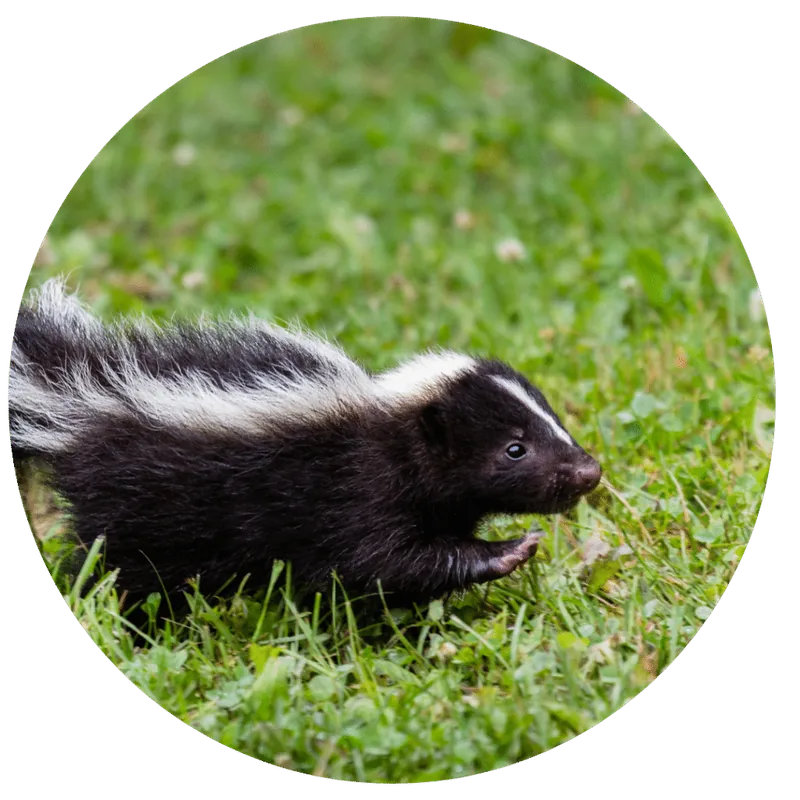



How do I know a skunk has moved in?
- A distinctive smell, even faint, that returns in the evening and at night.
- A 10 to 20 cm entry hole under the deck, porch, shed or garden house.
- Small cone-shaped holes in the lawn: it digs up grubs to feed.
- An animal seen at dusk, slow-moving, black with two white stripes and a long bushy tail.
The striped skunk is nocturnal: it rests during the day in its den, often under a structure near the house.
Get a free quote

Why not evict it yourself?
- A skunk that feels threatened sprays, and the smell soaks into clothes, pets and siding for weeks.
- It can carry rabies and canine distemper.
- In spring there is often a litter of five or six babies in the den: closing the access would trap them.
- Store-bought repellents and ammonia often have limited effect.
Bite, scratch or contact with saliva? Wash with soap and water for 10 to 15 minutes, then call Info-Santé 811.
We handle it, no spray.
Same-day service, 7 days a week. Free quote.

Our method
Den location
We find every access point under the deck, porch, shed or garden house.
Check for babies
In May–June, we confirm no babies are in the den before any closure.
Spray-free departure
Exclusion through a single open access, or capture in a covered cage when needed, in line with Quebec regulations.
Buried exclusion mesh
Small-mesh wire buried and bent outward under decks and sheds: the permanent fix.
Prevention advice
Sealed bins, no food outside, and odour neutralization if needed.
A fixed price, given before we start.
Exclusion mesh and advice included.
How do I keep skunks away?
- Use sealed bins with tight lids, put out on collection morning.
- Leave no food outside: pet food, open compost, seeds.
- Close off the space under porches, sheds and buildings.
- Protect gardens and coops with mesh of 5 cm or less, buried.
Frequently asked questions about skunks
Can a skunk spray during capture?
Very rarely with our equipment: our cages are covered and handled so the animal perceives no direct threat. Our technicians are specifically trained for this.
When do skunks move in?
Mating happens mostly in March and babies are born around late May, five or six per litter on average; they leave the den in early July. Skunks also look for shelter in the fall for winter. Exclusion mesh installed while structures are unoccupied is the best prevention.
Will the smell go away?
Yes. Once the animal is gone and the den is closed, the residual odour fades within days to weeks depending on ventilation. We can recommend neutralizers if the smell has soaked into a structure.
My dog got sprayed. What should I do?
Avoid plain water, which sets the odour. A mix of 3% peroxide, baking soda and dish soap works far better than tomato juice. If there was a bite or contact with saliva, see a vet quickly: skunks can carry rabies.
Official sources : Government of Québec — Striped skunk (FR) · Info-Santé 811
 Raccoons
 Squirrels
 Rats