
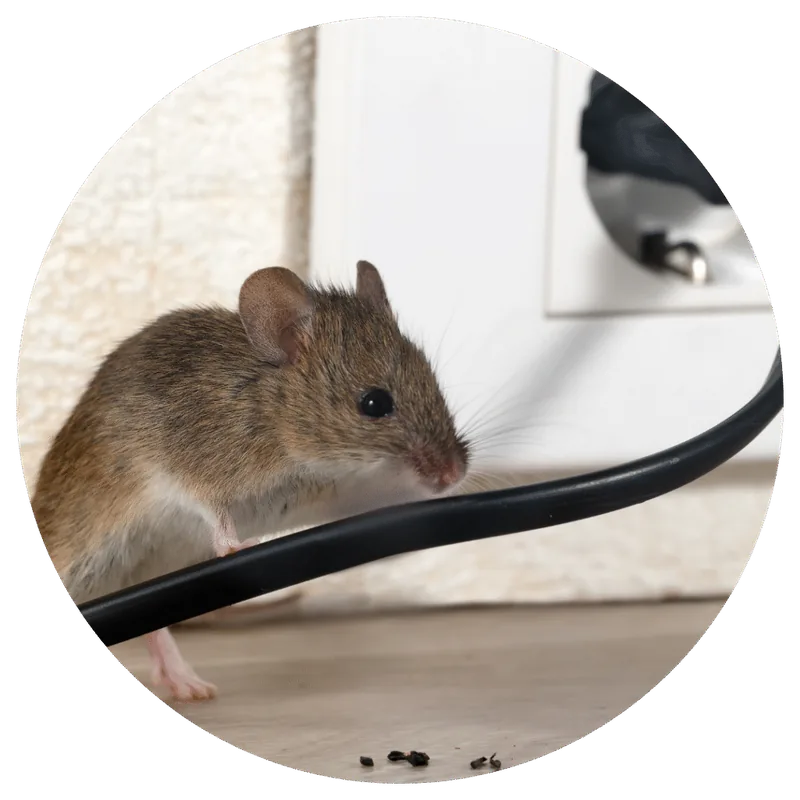


Why do I have mice in my home?
Mice and deer mice look for shelter that is warm, quiet and easy to reach, especially from September to March. Here is what attracts them:
- A crack in the foundation or a gap around cables and pipes.
- A poorly insulated crawl space, attic or garage.
- Unsecured food: seeds, pet food, garbage, crumbs behind appliances.
- Shrubs or stored items right up against the house.
- Nearby fields or woods: deer mice move into homes as soon as it gets cold.
A gap of just 6 mm, the size of a dime, is enough for a mouse to get in.
Get a free quote


I hear noises, I see droppings or chewed wires…
These are clear signs of an active infestation. The longer you wait, the more the colony settles in and breeds.
- Mice breed very fast: a family can grow from 2 to 60 mice in a few months.
- They chew electrical wires, pipes and insulation.
- They leave droppings, urine, bacteria and parasites behind: up to 75 droppings a day.
Signs that don’t lie
- Light scratching in the walls or ceiling, especially at night.
- Small black droppings shaped like grains of rice along walls, in cupboards or under the sink.
- Chewed packaging and small holes in food bags.
- A lingering smell of urine in closed spaces.
- Grease marks along baseboards: mice always use the same routes.
Seeing a mouse in broad daylight? The population is probably already large: they only come out in the open when hiding spots are full.
Every week counts.
Free quote, reply within 6 hours on average.

How do I keep them out for good?
These are the most effective prevention steps:
- Seal every opening, even the smallest, around the foundation, roof and walls.
- Install 1/8-inch galvanized steel mesh at entry points.
- Leave no food within reach, even in the garage.
- Avoid stacking wood, materials or objects against exterior walls.
- Have sensitive areas checked with a thermal camera if needed.
Above all: don’t rely on big-box store traps. They bring short-term relief but don’t fix the problem at the source.
Why call an exterminator instead of buying hardware-store products?
Good question. Here is the difference between us and a trap from a big-box store:
- Our products are professional-grade, far more effective and reserved for certified exterminators.
- We know where to place them, how many to use and how to handle rodents safely.
- We find the risk areas, including the ones you would never suspect.
- A badly placed trap or poison makes mice wary, or even spreads them to other rooms.
- We seal the entry points: a trap will never stop new mice from coming back.
The result: fast, lasting, guaranteed mouse control.
How does our treatment work?
Killing mice without blocking their way in means starting over every winter. Our method fixes the problem at the source:
Thermal camera: see the invisible
We locate nests and travel routes behind walls, under floors and in ceilings. No trap can eliminate what you can’t see.
A plan built for your home
Drywall, plaster, wood, brick: we know building materials and rodent behaviour, and we adapt our method to your building.
Tamper-proof bait stations
Health Canada-registered products in locked stations, out of reach of children and pets.
Entry-point sealing
Steel wool, galvanized mesh, sealing foam: we close every access point with materials mice can’t chew through.
Follow-up and 6-month written guarantee
A follow-up visit is included. If the problem comes back within 6 months, we return for free.
A fixed price, given before we start.
No hidden fees. Same-day service in most areas.
What to do while you wait for us
- Store all food in airtight containers, including pet food.
- Don’t plug holes yourself: a mouse trapped inside will cause more damage.
- Note where you hear noises and find droppings: it speeds up our inspection.
- Avoid store-bought poison: a mouse dying inside a wall smells for weeks.
Frequently asked questions about mice
House mouse or deer mouse: what’s the difference?
The house mouse (grey) lives in buildings year-round; the deer mouse (white belly) lives outdoors in summer and moves into homes in large numbers in the fall, especially near fields and woods. Treatment is similar, but for deer mice, sealing entry points matters even more because the pressure returns from outside every year.
Why is sealing so important?
Eliminating the mice you have is pointless if new ones can come in through the same holes. We close every entry point with chew-proof materials. That is what makes the result last, and it is included in our service.
How long does it take to get rid of mice?
Most infestations are eliminated within 1 to 3 weeks after the stations are installed and the entry points are sealed. A follow-up visit is included, and our 6-month guarantee protects you if the problem returns.
Are the bait stations safe for my kids and pets?
Yes. We use locked, tamper-proof stations placed along rodent routes, out of reach of children and pets, with products registered by Health Canada.
I only saw one mouse. Do I need an exterminator?
Often, yes. A visible mouse usually means others are hiding in the walls, and a family can grow from 2 to 60 in a few months. An inspection confirms how big the problem is and seals the entry points before winter.